

How to take speech therapy out of the "speech room" and into the real world
- Vocasafe Watch Team

- Nov 21, 2025
- 4 min read
Updated: Dec 14, 2025
The "Perfect" Session vs. The Real World: Bridging the Communication Gap
We’ve all seen it. The "perfect" therapy session. The room is quiet. The lighting is soft. The therapist sits across from the child, iPad ready. The child presses "I... want... ball." The therapist smiles, hands them the ball, and data is recorded. Success. But then the session ends.
The child walks out the door and into the cafeteria. It’s loud. Kids are shouting. A teacher asks, "What do you want for lunch?" The line is moving fast. The child freezes. The iPad is zipped away in a backpack because it’s heavy and expensive. In that moment, the "voice" they used so perfectly ten minutes ago is gone.
This is the generalization gap. It is the single hardest hurdle in AAC (Augmentative and Alternative Communication). It’s why so many parents find themselves searching online late at night for answers.
The Elephant in the Backpack

If you look at what families are actually asking online, you see the struggle immediately. A top search query is simply: "Is an iPad an AAC device?" The answer is yes. High-tech tablets are incredible. They offer robust vocabularies and are often covered by insurance. But there is a follow-up question that fewer people ask out loud but everyone experiences: "What are the disadvantages of AAC devices?"
It isn't the software. It’s the physics. Tablets are heavy. They are fragile glass screens. Naturally, we protect them with thick, rubberized cases. We tell kids, "Be careful," or "Put that away during recess so it doesn't break." We unintentionally create a rule: Communication happens when you are sitting down and safe.
But life happens when you are standing up, running, playing, and exploring. By keeping the device in the backpack to keep it safe, we are inadvertently keeping the child's voice in the backpack too.

The 6-Second Reality Check
There is another layer to this challenge, often called the "6-Second Rule." In the neurodiverse community, particularly for autistic individuals, processing time is real. The "6-Second Rule" suggests that after asking a question, you should wait six full seconds to allow a person to process and formulate a response.
In a therapy room, that silence is respected. In the real world? The world is impatient.
The cashier at the grocery store doesn't wait 6 seconds.
The kid on the slide doesn't wait 6 seconds before pushing past.
The teacher in a busy gym class can't always pause the game.
When the world moves too fast, and the AAC device is buried in a bag, the result isn't just silence—it’s frustration. It’s a meltdown. It’s behavior. Because if you can't say "Wait" or "Too loud" instantly, your only option is to react physically.
The Wearable Bridge: A Solution for Communication Challenges
This is why we built the VocaSafe Watch. We didn't build it to replace the iPad. We built it to bridge the gap between the iPad and the real world. When we look at "Who qualifies for an AAC device?", the answer should be "anyone who needs a voice." But that voice needs to be accessible within seconds, not minutes.
Here is how a wearable changes the dynamic:
Buying Time (The "Wait" Button)
Remember that 6-second rule? A watch is always on the wrist. If a child feels overwhelmed, they don't need to find a device. They can tap a "Wait" or "Thinking" icon instantly. This buys them the time they need to process, reducing anxiety immediately.
The Playground Test
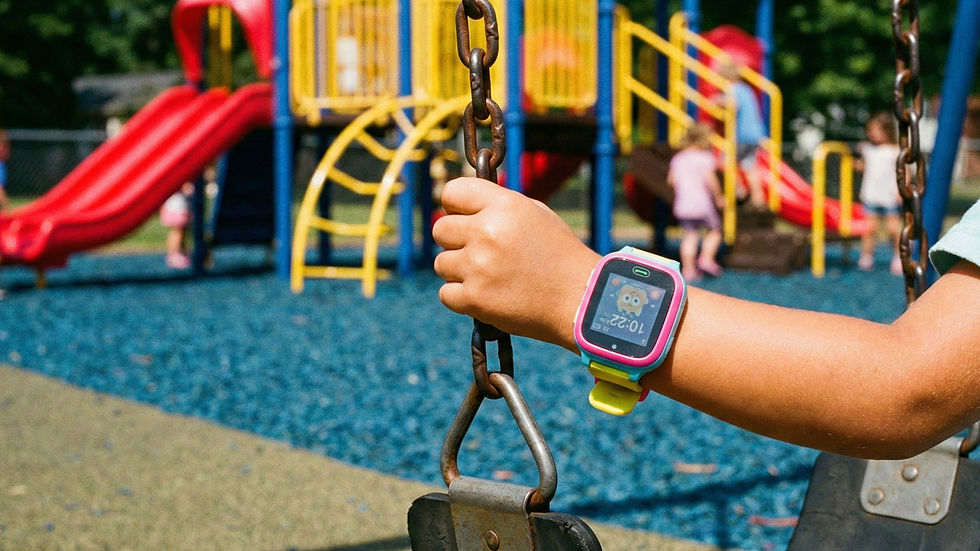
You can’t slide with an iPad. You can’t swing with a tablet. But you can wear a watch. This means a child can finally shout "My turn!" or "Stop!" right in the middle of the action. This is where social skills actually grow—not in a clinic, but in the sandbox.
Dignity for Older Users
We see searches for "AAC device for adults" because the need for communication doesn't stop at age 18. For a teenager or adult, pulling out a large tablet to order a coffee or ask for directions can feel stigmatizing. Checking a watch looks natural. It blends in. It offers dignity along with utility.
From "Patient" to Person: Empowering Communication
The goal of speech therapy isn't to be good at therapy. The goal is to be good at life. If we want to take therapy out of the "speech room," we have to give individuals tools that can survive the transition. We have to stop asking them to carry their voice in a backpack and start letting them wear it on their wrist.
Because the most important things a child has to say usually happen when they are furthest away from a desk.
Conclusion: A New Era of Communication
In conclusion, the journey towards effective communication for individuals with challenges is ongoing. The VocaSafe Watch™ aims to become the leading solution for individuals with communication challenges, giving them a voice and independence while providing peace of mind to caregivers through integrated communication and safety features. With tools like the VocaSafe Watch, we can bridge the gap between therapy and real-life situations, ensuring that every voice is heard, no matter where life takes us.
Let’s embrace this new era of communication and empower those who need it most.


Comments